The Baja Blaster
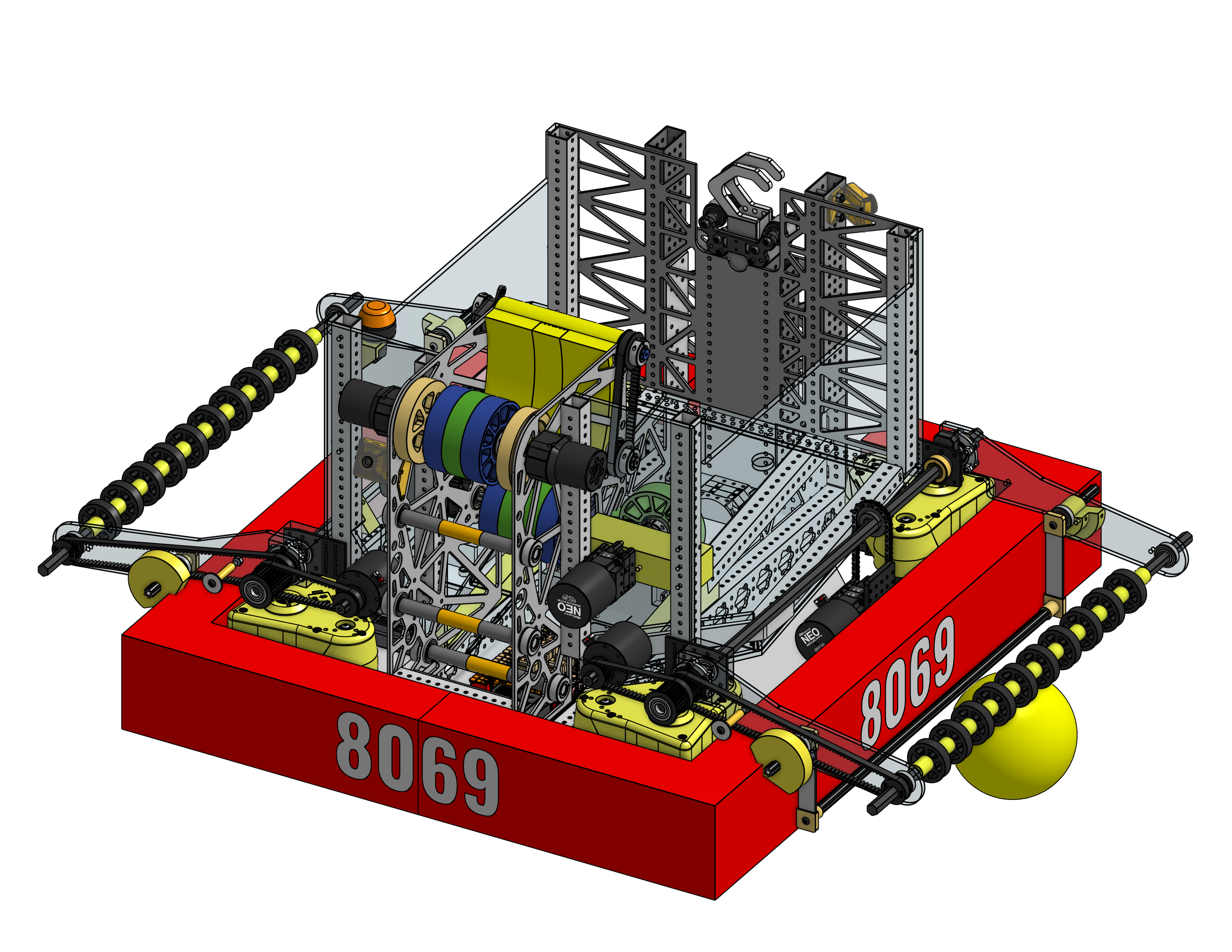
For the 2026 Rebuilt season, we built a robot which we named the Baja Blaster to compete.
Game Description
Matches open with a 20-second autonomous period where pre-programmed robots score Fuel and scale the central Tower. Drivers then take manual control for a 2-minute and 20-second teleoperated phase to navigate shifting field elements. During this main phase, active Hubs alternate between alliances based on real-time scoring data. Human players can also directly launch Fuel from the specialized Outpost zone to boost their score. The final 30 seconds trigger the intense End Game phase where all Hubs activate simultaneously. Ultimately, alliances secure crucial ranking points by crossing distinct scoring thresholds and maximizing their final Tower climb heights
Drivetrain
The drive train is one of the important parts of the robot. This is our third year using swerves. We switched from Max Swerves to Thrifty Swerves and used two Kraken X60s on each swerve module to propel the robot. We use Max Tube with the MAX Pattern as our two cross braces, which allows us to tie our frame directly to the rest of our components and run wires through them. This is the first year with a solid aluminum belly pan because we were cautious about getting stuck on game pieces. It was also the first year we decided to organize the wires so we wouldn’t have to scramble to find where a wire goes. In addition we added stress loops so that wires would not break. This year, we split the bumper into two pieces to make it easier to install and remove from the robot.
Software
This was the first year we used vision on our robot. The robot uses cameras and we programmed it with PhotonVision so it can see where it is on the field, and it aims at the hub with the press of a button. It can also measure its distance to the hub and adjust the shooting angle and speed accordingly. The robot can also aim at the hub and shoot in autonomous mode. We used global shutter cameras, which means that every pixel is captured at the same time. Other cameras take pictures one pixel at a time, making the AprilTags stretched and harder to read while the robot is moving.
Ins and Outs of the Intake
The intake consists of two roller bars with rubber wheels, which provide the grip necessary to feed the fuel into the robot’s hopper. The first roller pulls in the balls, and the second directs them into the hopper. A bar folds down in front of the bumper and keeps the compression of the ball consistent. The original design included two single roller intakes, one on either side of the robot. However, they relied too heavily on gravity and were replaced by the current innovation. All in all, we got very familiar with disassembling and reassembling this particular part of the robot
Shooter
Our shooter was very precise this year. It feeds the fuel up into a wheel that spins at a couple thousand rpm. The wheel is powered by two motors and two half-pound flywheels. It is so powerful that it has hit the thirty foot ceiling in our shop. There is a hood in the back could articulate to change the angle of our shots in order to aim into the goal. CADing the robot allowed us to send the files for the side plates to Send Cut Send™ to be cut out of aluminum.
Hopper
The hopper was quite a challenge this year. One of the challenges we faced was the fuel (yellow balls) jamming in the hopper. This made it so we could not shoot consistently. We made prototypes out of wood and went through many, many, many, many iterations. Our final product was made out of polycarbonate and 3D printed pieces. It has significantly less jamming than we had in the beginning. We had a cone in the middle with walls which forced balls towards the feeder. This allowed us to have a decently fast fire rate.
Competition
Saint Louis Regional
You have to earn a certain number of criteria to be top team which gets in the spot to go to Worlds. We scored 30 playoff points by the time we won the St. Louis Regional Competition which is the maximum amount of playoff points you can get. You have to win an award in order to go to the FIRST Robotics World Championship, and we did, in fact, receive the Imagery Award which got us 5 award points that helped us go to Worlds. Performance in Qualification rounds was crucial for getting us to Worlds as well, we earned 11 qualification points, and you cannot get selected by an Alliance without getting good qualifying points. We earned 47 points overall that ranked us high enough to go to Worlds this year, with one point being attributed to winning with our Alliance of teams 1706 and 3931, all of which came to Worlds and saw us there.
Championships
FIRST Championship 2026 presented by BAE Systems is an international robotics competition and an annual event for the youth in the worldwide robotics community and STEM education celebration. For over 30 years, FIRST has educated youth communities around the world with robotics and brings them all together in the FIRST Robotics World Championship. FIRST World Championship is separated into 8 fields: Daly, Galileo, Archimedes, Hopper, Newton, Johnson, Curie, and Milstein. The winning Alliance of each field advances into the FIRST World Championship playoffs. We participated in this World Championship in 2026 and learned a lot. Many sponsors participate in this Championship too, by setting up booths and showcasing their products and technology.
Awards
During the 2026 competition season, we won two awards at the St. Louis Regional: the Imagery Award and the Winner Award. The Imagery Award is an award based on the outstanding theme of the team and how well the team is represented, as well as team spirit and overall composition. Our team received the Imagery Award for our unique yellow shirts, hazard stripe theme, pit design and various merchandise, such as the claw machine or button badges. Our team also won 1st place alongside our alliance at the St. Louis Regional due to our unique strategy and efficient design. This was our first ever win at an official competition, and we are thankful to have it as a part of our team’s history.